
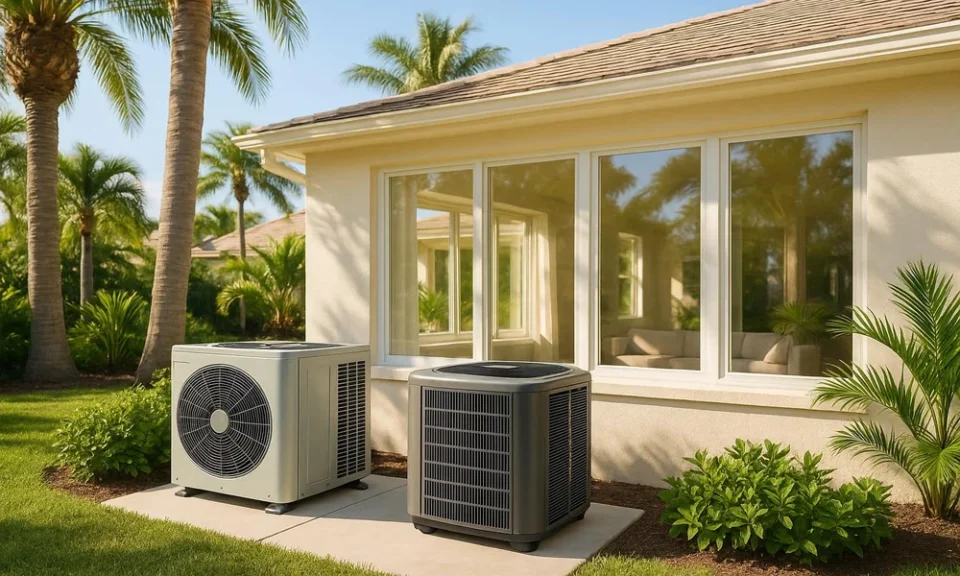
My neighbor’s August electric bill hit 340 dollars, and his house is nearly identical to mine. Same square footage, same builder, same street. He runs a standard central AC. I run a heat pump, and my worst summer bill last year landed around 210 dollars. That gap is not luck, and it is not a fluke of the thermostat. It comes down to how a heat pump moves heat instead of generating it, and how much that matters when the outdoor air sits at 93 degrees with 80 percent humidity for months on end.
If you are weighing a heat pump against a traditional system, here is the short answer: in a Southwest Florida climate, a properly sized heat pump usually beats a standard split system on both cooling cost and summer comfort, because it dehumidifies better while sipping power. It runs on roughly a quarter of the energy a traditional system needs to do the same job, because it relocates heat rather than burning electricity to create it. Plenty of local homeowners now lean on heat pump services Sarasota FL providers for the install and tune-ups, and there is a good reason that category of service keeps growing here.
What follows is the part most homeowners never hear: the equipment brand matters far less than sizing, airflow, and the drain line. Get those three right and you will feel the difference in your first full billing cycle.
Why a Heat Pump Wins in Sarasota’s Climate
A heat pump is one machine doing two jobs. In July, it pulls heat out of your living room and dumps it outside. In January, when we get that random 44 degree morning, it reverses and pulls heat from the outdoor air into the house. A furnace would have to burn fuel to make that warmth. A heat pump just moves it.
The U.S. Department of Energy explains that a heat pump can deliver several times more heating energy than the electricity it consumes, which is why it is one of the most efficient ways to condition a home. That ratio is the whole ballgame. You are not buying colder air, you are buying the same cold air for fewer kilowatt hours.
Humidity is where the argument gets interesting. A heat pump runs longer, lower cycles than an oversized AC unit that blasts on and off. Longer runtimes mean more moisture pulled out of the air, and Southwest Florida air is basically a sponge. Tighter humidity control also lets you set the thermostat a degree or two higher and still feel comfortable, which quietly trims the bill again.
What Actually Drives Your Cooling Bill
Equipment efficiency is maybe 40 percent of your bill. The rest lives in the house around it. The U.S. Department of Energy notes that heating and cooling account for more than half of the energy a typical American home uses, and that leaks, poor insulation, and duct problems waste a meaningful slice of that.
Here is where I will plant a flag. If a contractor quotes you a new heat pump without measuring your duct static pressure, walk away. I have watched two friends buy premium 18 SEER2 systems that underperformed because their return duct was undersized and their attic insulation was from 1998. The equipment was fine. The envelope was the problem.
To give those numbers context, figures from the U.S. Energy Information Administration show that Florida homes lean on electricity for cooling more heavily than most of the country, which means every efficiency point you gain hits your wallet directly.
| Bill driver | Typical impact | Fix |
|---|---|---|
| Oversized or undersized system | High | Manual J load calculation before install |
| Duct leakage in attic | Moderate to high | Duct pressure test and sealing |
| Dirty filter and coil | Moderate | Monthly filter swap, annual coil cleaning |
| Thermostat schedule | Low to moderate | Programmable or smart setback |
How to Size a Heat Pump Without Guessing
Sizing is not “bigger equals better.” A unit that is too large cools the room fast, shuts off, and leaves the humidity behind. It also cycles hard, which wears the compressor. What you want is a load calculation, sometimes called a Manual J, that accounts for your window count, insulation value, ceiling height, and the direction your lanai faces.
The practical sequence looks like this:
- Ask for a room by room load calculation in writing.
- Request duct leakage testing, not just a visual glance in the attic.
- Confirm the quote lists line set size, drain line routing, and a float switch.
- Get the expected SEER2 rating and the warranty terms on the compressor in writing.
- Ask who handles the permit and the final inspection.
Notice that only one item on that list is about the machine. That is deliberate.
The Fall Maintenance Checklist That Saves You Money
Late October is the sweet spot here. Summer is over, the system just survived its hardest stretch, and winter heating demand is still weeks away. Run this once and you will catch most problems before they become emergency calls during a holiday visit.
- Rinse the outdoor coil and clear grass clippings from the base.
- Replace the filter, then set a phone reminder for 30 days.
- Pour a cup of water into the condensate pan and confirm it drains.
- Trim vegetation back at least 18 inches from the condenser.
- Check that the auxiliary heat strip only kicks on below your chosen setpoint.
- Look for rust streaks or oily residue around the service valves.
Odds are good that four of those six items take you under an hour. The drain pan test is the one people skip, and it is the one that causes the most water damage claims I have seen in this county.
Repair or Replace?
This question comes down to money and age, and I have a clear rule. If your heat pump is under ten years old, the repair costs less than 30 percent of a new system, and the part is a blower motor or capacitor, repair it. If the compressor has failed on a fifteen year old unit, or you are facing a second major repair in two years, replace it. Compressor swaps on aging equipment rarely pencil out because the rest of the system is on the same clock.
There is an environmental angle too. The U.S. Environmental Protection Agency oversees refrigerant rules that have pushed newer systems toward lower global warming potential refrigerants, so a replacement today uses a different refrigerant than what is in your 2009 unit. That matters for future service costs as older blends get phased down.
Think about your own pattern. Have you called for service twice in the last twelve months? Have you noticed the system running all afternoon and still not holding 76 degrees? Those are replacement signals, not repair signals.
Questions Worth Asking Any Contractor
Credentials are easy to check and rarely checked. Ask whether the technicians are NATE certified, whether the company pulls the permit in its own name, and whether they offer a written maintenance agreement. A maintenance agreement is not a sales gimmick if it includes two visits a year and priority scheduling in July, which is when every company in Sarasota is slammed.
Also ask what happens after the install. Who do you call at 9 pm on a Saturday when the house hits 84 degrees? If the answer is a national call center, keep looking. Local accountability is worth real money when your family is sweating.
Bottom Line
The efficiency gap between my house and my neighbor’s is not a mystery, and it is not a gimmick sold by a slick salesperson. It is sizing, airflow, humidity control, and a maintenance habit that takes about an hour twice a year. Do those four things and your heat pump will pay you back every month from May through October.
So here is your move this week: pull out your last three electric bills, find the highest one, and ask yourself whether your current system is earning that number. If it is not, get a load calculation done before you get a quote. The math will tell you everything you need to know.
